
Introduction to blog 21 – My Personal Journey in Om Divine Grace Yoga.
The four specific components of Om Divine Grace Yoga are enumerated in the first five blogs Then blogs move on to a broad view of my own Om Divine Grace Yoga spiritual journey. Then comes the teaching material associated with this pathway. Blog 21 is the Appendix, with summaries/reminders & some additional information. This is the last “chapter” of the book Om Divine Grace Yoga, which is now published on Amazon. Plus eBook via Draft2Digital.
Om Divine Grace Yoga is designed to enable practical use by a practitioner interested in this pathway. Of course anything here can be approached as just reading matter of interest.
Historically, this pathway is approached via a Guru for initiation and guidance. In our modern world this might not be feasible or practical, given the nature of this dark era (Kali Yuga). It may not be possible to get a guru who can assist you in this area.
It is necessary now to offer this spiritual pathway and process as an option for any practitioner, desiring progress.
Om Divine Grace Yoga.
Appendix (Part 1)
Refresher of the main component topics
What is?
Vedanta: Means literally end of the Vedas, and is a part of the vastness of Hindu philosophy. Vedanta however, on the surface, seems to oppose the Vedic & Hindu religion in a major way and on major points, and separates away from the concept of worshiping many gods or performing rituals. God is one transcendental state, without specifically denying the value and purpose of a personal god. It does critically analyse Vedic sacrifice and worship of the various deities, and even penance of the yogis.
Vedanta seeks to clear away the clutter of ritual, and point to the discovery of the inner soul, the Atma, which is one with the cosmic soul, Brahma. Vedanta is not the pathway of devotion to a Personal God. It is a way of being already perfected souls in oneness with the whole of creation. It may be hard to swallow, that we ourselves are God, as the Atma is the same substance as Brahma. The Vedantic mantra is Tat Twam Asmi – That I Am. Or the mantra, Soham – I am that (Brahma), meditated on with the inhalations and exhalations of breath. I am Brahma, Cosmic Consciousness.
Kundalini: Otherwise known as the serpent power, which is considered to be like a coiled snake of energy at the base of the spine. It can be coiled there in a dormant state & when awakened the energy or Shakti arises in a sinuous movement through the centre of the spine to the crown of the head. Along the way are centres of energy called chakras and each one of those chakras has specific and particular attributes.
Shakti: Considered to be the universal energy or Goddess energy – the creation force of the divine being. In this sense the masculine aspect of divine being is seen as a transcendental power which is beyond form and shape & the female aspect is seen as the external creation. When practitioners worship the Shakti or Goddess form they can worship the divine being as the world, the universe, or creation.
Mantra: Is a Sanskrit word. The first part of the word means “constant thinking of” The second part of the word means “that by which one is protected.”
So by the conscience thinking of a certain word one is “protected’, where the word protection has a wider connotation in spiritual terms, as being a means to a degree of perfection (siddhi). The part Man means literally to think and the word Tra means literally to protect or free. The repetition or use of a mantra is considered to be enabling of a range of outcomes, from enlightenment down to the acquisition of wealth and pleasure.
The repetition of a mantra is called Japa. In Hinduism it is said in Scriptures that in this age, the Dark Age, (Kali Yuga), that the repetition of certain mantras is the easiest way to obtain enlightenment. However there may not seem to be much science or evidence associated with such a view.
Chakra: In Sanskrit, chakra translates into “wheel”. These “wheels” can be thought of as vortexes that both receive & radiate energy. There are seven major energy centres or chakras, in the human body. They run from the base of the spine to the crown of the head. Emotions, physical health, & mental clarity affect how well each chakra can filter energy. This in turn dictates how pure the energy is that’s emitted from different regions of the body.
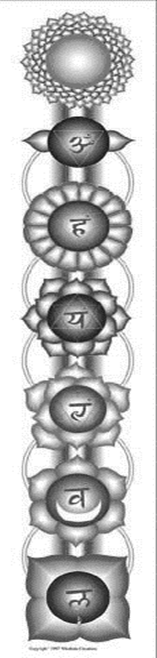
Seed Tantric Mantras with their chakras – (My core teaching – which is additional to the sounds depicted inside the chakras by most treatises).
This is specific to Om Divine Grace Yoga as expounded by me, & derives from my Goddess Inspired Realizations about which seed Tantric Mantras relate to which chakras.
Om (Source of all). Sahasraram Chakra – Crown chakra
Om (Source of all). Ajna Chakra 3rd eye – OM
AIM – (pronounce Aiim), Bija mantra of Saraswati, Vishuddha Chakra – Throat chakra
HRIM – (pronounced Hreem), mantra of Divine Maya.. Anahata Chakra – Heart Chakra.
SHRIM – (pronounced Shreem), relating to Lakshmi. Manipura Chakra – Solar plexus chakra.
KRIM – Krim, (pronounced Kreem), Svadhisthana Chakra – Sex (or Water) chakra.
KLIM – (pronounce Kliim). Kameshwari, goddess of desire. Muladhara Chakra – Root (or Earth) chakra
Summary/reminder – Use the seed mantras as below.
Om
Aim, Hrim, Srim, Krim, Klim
AIM – (pronounce Aiim), the bija mantra of Saraswati, the goddess of learning.
HRIM (pronounced Hreem) is is the mantra of the Divine Maya. Through it we can control the illusion power of our own minds. Mahamaya, is the goddess of power over the created universe (of illusion).
SHRIM (pronounced Shreem) is a mantra of love, devotion and beauty, relating to Lakshmi, the Goddess of Beauty and Divine Grace, who gives us the good things of life, including health. It aids in fertility and rejuvenation. Lakshmi is the goddess of wealth (in its broadest sense).
KRIM (pronounced Kreem) is the great mantra of Kali, has a special power relative to the lower chakras, which it can both stimulate and transform. It a main mantra of the Tantra. It should be used with care. Kali, the fierce goddess, has the power to destroy.
KLIM – (pronounce Kliim), the bija mantra of Kameshwari, the goddess of desire or contentment and satisfaction.
Seed mantras with their chakras – (My core teaching)
Om goes with the the top two chakras, then Aim, Hrim, Shrim, Krim, Klim in descending order corresponds to the other chakras.

 Om Divine Grace